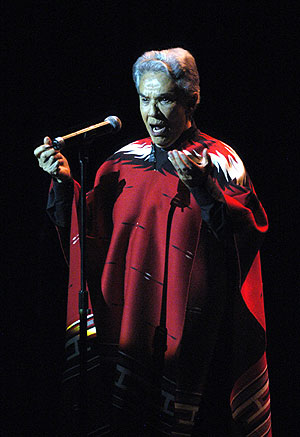
A woman wearing red poncho, short hair and never wore skirts. Despite being born in Costa Rica, his heart is with the Mexican people. A woman with a throat that embodies the romantic woes of the people.
There is a woman whose face denotes rows of penalties and joys. And his throat, he had drunk 45 thousand liters of tequila, is a legitimate label to have lived. In the throat, a feat that voice is endearing song is a cry that while a lullaby. A paradoxical magic traps us to hear it sing, it keeps us alert and contemplative time we dispersed into our dreams.
There is a woman, muse of poets, painters, filmmakers and musicians. Fell in love with Frida Kahlo, Diego Rivera inspired, met Trotsky and Carlos Gardel. A woman who got the punishment not be so bitter when his voice the tone, the stains of life and intensity.
that the gift of music, to make it resonate in every corner of the spirit. The words out of his mouth, float, flow ...
There is a woman who never played with dolls and likes guns. That has a slight limp for having pulled the window by a disappointment in love. Nearly 60 years ago singing romantic woes, squeezes your heart in every line.
There is a woman who has lived and few. There is a woman who calls ...
The ranchera and bolero are not the same since she's singing. That's why many times about certain genres from their interpreters is more dynamic, more agile .
Chavela played in the 1970 album that contains 12 traditional calendar legendary classic entitled Simon Blanco dedicated to one of the heroes of the Mexican Revolution.
A genre can be defined and determined theoretically. But after all these theoretical devices are always after the same creations of composers and performers. The music is experience, practice, have to listen. And who better to listen to Chavela to discuss Boleros, Valses and Ranch.
daughter of Herminia Lozano and Francisco Vargas rancher, was actually born in Costa Rica in
Musa poets and filmmakers, Chavela Vargas lived the golden decades of Mexico, the forties and fifties, and his name is associated with figures like Frida Kahlo, Diego Rivera, Agustín Lara and already in the 90 'the filmmaker Pedro Almodovar.
Sensual and torn, his voice has sung of love and jealousy, squeezing his heart for over 50 years, we could say that the singer Chavela is larger, age and talent, song Mexican.
began singing with her art on the streets of Mexico since the mid of the 50 hand of the compositions of Mexican musician José Alfredo Jiménez was fascinated his audience to reach the peak popularity in the 60 and 70 after recording his first album in 1961.
could say that the kick was made around the 50 of the hand of "Macorina." A song that has verses from the poet Alfonso Camin who was inspired by a beautiful Salvadoran racial crossover black and yellow. Chavela Vargas set to music and performed with their own arrangements influenced by the Cuban Danzon. Thus, the popularity of Chavela acquired amounted to "Macorina" Hymn to the category of Latin American guerrillas.
mariachis sets originating in Jalisco and whose name comes from the degeneration of the French word mariage (wedding) attributed its usual liven up the wedding party were in charge of broadcasting in post-revolutionary Mexico's ranchera song, native musical variety that symbolized the emergence of a new national consciousness.
ranchera music is a genre of folk song accompanied by the orchestra features that first appeared in Mexico in the early twentieth century.
The 1910 revolution in Mexico marked a profound change in the political conception of this country and was accompanied by new cultural manifestations . Thus, the ranchera music was born as a reaction to popular sources aristocratic European models dominated environments of Mexico off.
This music was inspired by the spirit of Mexican folk dances, whose festive, as in the case of huapango, precursor of La Bamba, combined with a story line of lyric or epic nature.
proliferated during the revolutionary years of chronic sung the deeds of men, women and armies. This form of romance, called run, acquired own style and technique which, from its origins, related closely with Ranchera music, a genre developed considered independent.
The ranchera song that developed its golden age alongside the likes of Jorge Negrete, Pedro Infante and Javier Solis who, during the 1940's and 1950's immortalized in recordings and films record the sound and the archetypal image of the performers of this genre.
Chavela appropriated the rancheras, boleros and waltzes composed by Jose Alfredo Jimenez, the musician born in Guanajuato, Mexico in 1926 and innundó to say about her voice and interpretation. Chavela itself described his admiration for Jose Alfredo Jimenez as an artist as she opens worlds
victim of alcoholism in 1979, Chavela had to retire from the stage and 12 years had to pass until singer returned to show business, this time thanks to the movies.
accepted work in Werner Herzog's film "Cry of Stone" (even traveled to the Patagonian Argentina undercover to film). A year later, Pedro Almodovar made Chavela, one of its girls. "The Vargas
returned in 1993 after decades without recording to a studio and recorded several of his classic hits as well as traditional songs from his repertoire compiled in the album titled "La llorona" which was recorded in Madrid and next year in Madrid, shaped the album "Macorina" which includes a special version of the tango by Carlos Gardel and Lepera "His Eyes."
His love of the tango and his admiration for Atahualpa Yupanqui is obvious. Chavela's relationship with Argentina in turn was spelled for songs by local artists who has played some examples of this are: ("Black Maria" by Homero Manzi, "Song of the simple things" Armando Tejada Gomez, " Thus, Sandro.
Knowing Gardel said the report that time:
I met Carlos Gardel, the RCA Victor Studios in New York. I said, "Lord, permit me to turn around you to see it everywhere?". And he died laughing. A handsome man, well groomed, very beautiful.
Chavela approaches the Argentine tango, as she knows close to each gender. Tiñiendo of the song itself, making itself. As this version of "His eyes were closed."
But I think it's more interesting to share this version that led to performed together the theme of Joaquin Sabina "Wedding Night." This is a version that has a funny prologue Chavela where it has become known as Sabina. The way to tell and tone of voice provide a nice touch of humor.


0 comments:
Post a Comment