Tuesday, November 16, 2010

Where Can I Find A 100x100 Multiplication Chart

The City Brand


Sebastián Endara

For those who work in culture has proved an unpleasant surprise to find in the back of improved event calendar month of the city of Cuenca, - especially for its picture-the short-sighted attempts to argue for the so-called 'city brand'. It is unfortunate that a statement is made so weak in favor of the logo that suggested the current political administration as a distinctive, legitimate, and all of the city would have been better to stop reading to sensitivity.

image: cuenca.com.ec

This entry sign has not been agreed by anybody, because nobody remembers who have been debates on the issue, and therefore lacking of legitimacy, came not from the genius of the people, but at most, in a marketer, albeit uninformed, cultural dynamics of the city and most likely of the cultural debate around the issue of popular imagination. The explanation of this sign, which critics, which is made to represent the very essence of our identity and diversity, with errors of structure. Input concepts confused: I would bet anything that no is, in any treaty of ethics, safety and value. Out of joy, solidarity and equity, who would think to put as the value of culture or modernity? And just as confused concepts, misrepresent their own details which constitute the region's cultural heritage. If you look at the chola representative of the 'city brand' is - well beyond that is not our chola-area reliable brands such as ikat skirt and are fused with a blouse, a hat, some accessories not belong to the tradition of the region. Will defend talking of hybridity, however, this reflects at least falsification, disinterest and a lack respect for tradition, built in the local government, the degree of value, which deny contradictory.

But most important of all, from defending the 'city brand' in accordance with the laws of the kind of marketing guru 'John Doe', gives us clues as to where it is pointing and where it is thinking about the imaginary identity of the city. A sign absolutely false and to say the least, pulled hair, without a real reference only to the city, as determined by forced ideation, but yes, definitely tied to try to install a trend that is being challenged worldwide by citizen movements, the aberrant commercial utopia in the era of consumerism and advertising supermarket. The 'city brand' we fully inserted into the structure of apparently not being. At this time the brand is what sells is the brand that projects the image of a city like mature product, ready to be eaten, regardless of their educational processes, historical and citizens.

But against this, against a proposed corporate identity designed by city designer outdated technocracy-not-cultural researchers, stands the proposal for the construction of popular representation, the construction of meaning and meanings of life, communication Building an alternative but to understand the complexity of the codes of recognition and perception of imaginary people. Can not neglect the cultural processes of a city that has a special basin on cultural empowerment, as you can not open streets with alternative pathways for mobilization (bicycles), which in reality serve to park cars, without losing credibility and solvency policy. We recommend to the Mayor to advise on issues of culture that is an underlying theme in the new processes of political construction.

To see the cultural agenda (particularly the section that referred to) go to the page: http://www . municipalidadcuenca.gov.ec /? q = node/542

Monday, October 25, 2010

Destination Wedding Travel Information Letter

September 11, 1973 in Chile and Ecuador

Lizardo Herrera

The June 29, 1973, the Argentine-Swedish cameraman, dies at Leonardo Henrichsen streets of Santiago de Chile. Henrichsen was filming the coup known as the "tancazo" against President Salvador Allende. To his misfortune, as his camera focused on a group of military rebels, one of them, Corporal Hector Her nán Gomez Bustamante, was shot in front and close range. Immediately, we see as the camera becomes unstable and falls Henrichsen the ground filming his own death.

Why talk now Henrichsen? What is the point of death in Ecuador from October 2010? In Chile, the Popular Unity government (1970-1973) built his platform of government from the idea of \u200b\u200ba socialist revolution through peaceful and democratic. This ideal was well received among the poor, who mobilized to elect and support the government of President Allende.

(antropologiavisual.cl)

The great Chilean documentary filmmaker, Patricio Guzmán, The Battle of Chile, tells in three parts, from the perspective of what he calls the struggle of a people without arms events culminating in the dictatorship of General Augusto Pinochet on September 11, 1973 and the death of President Allende. Guzmán shows, in the first half, the Chilean right was gradually creating the conditions for the coup, the second, can see how you conducted this coup and, third, we see that the popular sectors and unionism, who with unprecedented mass organization - "the people without arms" - different ways of breaking the political deadlock and economic and fought to defend the Popular Unity government which they saw as their own.

The current president of Ecuador, Rafael Correa, like Allende built his political platform from the offer of a peaceful revolution at the polls and also enjoys a high popularity. But unlike the Popular Unity government, first, not forced to permanent and then confronting irrational obstructionism of a parliamentary majority, which in 1973 openly advocated military intervention to oust Allende. Second, Correa has an ongoing conflict with trade unions and social movements and gives to his government a highly technocratic tinge that sets it apart from the Popular Unity.

However, both governments agree on the creation of an environment where extreme polarization as well as my friend Esteban Ponce says we are increasingly forced into siding with an option to reject the other missing the nuances so necessary to preserve a truly critical and progressive attitude. Ie, low sinking down into a perverse game in which criticize a means positioned himself aligned with the other. In the case of Chile, the radical polarization, despite my great sympathy with the government and the figure of Allende, led the country to the brink civil war where the political field was divided into two irreconcilable sides, or was with the reactionary right to disqualify as "filthy communist" or sided with what the left branded as "criminal odds." Was gradually losing the ability to build bridges between different groups and attended a relentless class struggle where the other was defined as the enemy. This polarization, as expected, the disadvantage both in Congress and in Amadas Forces led to the irrational right victory with the subsequent implanting of a dictatorship it will be no other adjective than criminal, which handled admirable sweep the grassroots organization that supported the Allende government, although the organization for the most popular was not armed should be clarified as well as shows Guzman factions of the Socialist Party and the MIR promoted the delivery of arms to the people or the resistance Navy and the radical discourse was one of the evidence he sought and used the coup to impose terror.

In the current circumstances of Ecuador, it is clear that the Correa government has openly touched the interests of powerful groups that were long entrenched in the state and immorally usufruct of the latter. The reaction of these groups was furious espererarse has been expanding a series of lies and fears to destabilize the government. However, in my opinion, Correa has also reacted badly, especially, reifying the position of "technical" to silence those who think like him. Therefore, the recurring phrase: "Trust us because we know what we do, we are well prepared." As in Ecuador, most technicians are not we would have no other way to trust the president. In addition, Correa's speech also contributes to the polarization often unnecessary because not only directed against the conspirators, but attempts to establish a principle of authority to disqualify the other by multiple insults and prevents many-Ecuador is primarily a diverse nation, we join a project that concerns us all. Appealing to trust, use bigoted language and prevent the effective participation of different sectors of the population, from my point of view, is not a democratic position.

However, I did not bring to mind the image of Leonardo Henrichsen to attack the government, but to bring some more rationality to the political debate in Ecuador. In Chile, after the failed uprising of "The tancazo" right irrational immediately came to shout that there had been no coup attempt, it was all a mañosería the incumbent government, a self-coup, to achieve a dramatic effect on public opinion. At home, the opposition has taken the same turn hypocrite and say the same about the unfortunate events of 30 September.

Beyond the "rebellion police", to which there have been named after "The Chapazo" was planned or not, personally I am inclined to think so, "is a foolish not to consider that in this life insubordination President was in danger and it was held against his will in the Police Hospital. So now defending the rioters as people who claimed only their professional interests maliciously means hiding the real problem. Nor can we overlook that in this case the rebellion is an armed character and when the military or the police take up arms there is always the risk of someone illegally taken power by force. It is also now the rightwing opposition in Ecuador, like the Chilean 73, contradictorily argues that ideology critique: a union demand. The neoliberal discourse flies in the fiscal deficit and, therefore, any vindication in the public sector salary because it goes against the fiscal austerity, something similar happened in Chile with the strike of the mine of El Teniente or truckers.

But worst of all is that now appear always demagogues who claim to defend human rights of police officers. It is true that we must defend the rights of our officers with determination, courage and frontal, for the life of each one of them is important, but this does not mean they have carte blanche to violate human rights of others for more that these be criminal. Human rights are universal and not selective. In this case, selectivity is rather an indication that you wish to use no less criminal forms of violence such as Pinochet did to end what the dictator and his camp described as "filthy communist" or "the evil influence of Marxism ".

If the right and the opposition complain of the intolerance of Correa, I propose instead that contribute a goodwill gesture to his senses, stop looking for the fifth leg, openly condemn what happened on 30 September and work together to punish the rebels. Any person who believes in democracy is obliged to energetically condemn all forms of insurrection in law enforcement because that involved an armed force that takes advantage of the weapon unlawfully against a public sector of the population is disarmed. If we demand more rationality on the part of government, we do not fall into irrationality to justify the unjustifiable because democracy contradicts with any kind of rebellion in the armed forces or the police for more than just that they could be.


Tuesday, October 12, 2010

Decreased Cervical Mucus In Early Pregnancy

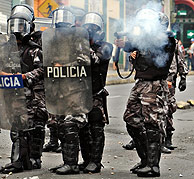
spectra in the coup attempt "or riot police?


Pablo Ospina Peralta [1]

Quito, October 7, 2010

day following the events in a long interview with public television, Rafael Correa stated abundantly clear thesis official: the salary problem the police mutineers claimed publicly to justify his insubordination was a common excuse. There was an inte nt coup engineered by conspirators linked to the Patriotic Society Party of ex - President Lucio Gutierrez and, failing to arouse the plan of the armed forces opted to "plan B" to kill the President. Discontent with the changes in the remuneration scheme tions of the police could be the cause of the uprising because the Public Service Act, even eliminated bonuses for medals and promotions, total wages increased to include payment for overtime . Above all, stressed the President, government support for the institution would have been significant sharp increase in wages between 2007 and 2010, improved operating equipment, investments in physical infrastructure. Therefore, given their titanic public efforts soon forgotten, be felt deeply betrayed [2] .

The thesis of the mutiny, p or the contrary, argued that there was no coup attempt. He never made any claims go LPIS ta and virtually all senior police officers sought appeasement. The kidnapping or retention of the President, the danger who ran his life and the violence of the events linked to the rescue on the evening of Thursday, are due to the warming of the minds as went chaining improvised events caused by the fury of the moment. The decisive aspect of this outbreak of violence and kidnapping that threatened the country's institutional stability, would have been imprudent actions of the Chairman in the early hours of the morning when he went personally to the regiment nt No. 1 in Quito to solve the problem. They ended up losing his composure and defiance of the rebels: "Gentlemen, if you want to kill the President, here it is: kill me. If they please, kill me, if they have value, instead of being in the crowd, cowardly hiding (...). If you want to take the barracks, (...) If you want to betray their duty (...), if they want to destroy the country, destrúyanla (...) [I give] Not one step back. " This intervention warmed the mood and triggered the sequence of events leading to the mutiny gre convert mial in a kidnapping that could cost him his life [3] .

What to make of these conflicting interpretations? The information is, of course, fragmentary, secret, impervious to scrutiny. We offer here a provisional and plausible speculation based on fragmentary information at our disposal.

alternative thesis

The first point to consider is that in the early hours of the morning, the police strike was not an isolated event in a particular battalion. It was a rally without police left the country. From the information available, only in the cities of Cuenca and Esmeraldas, the troops of the police returned to work after talks with his superiors. This indicates that there was conspiracy, there was also a massive boost to the "excuse" or union wage. How do you explain the massive support the ruling party? Basically by disinformation the agitators, the lies repeated use s that police had not read the law carefully and were unaware of the benefits it brings. In a word, cheating.

This explanation "intellectualism" is not satisfactory. It assumes that a very rare in Ecuador's history, a national police strike (the last dating back 1980), may be due to agitators who cheat easily amenable to mass. The truth is that agitation is effective only where the environment is receptive. Not only that, two senior officers, the Chief of the Joint Command of the Armed Forces, on Thursday, and Commander Chief of Police, when he resigned on Friday, in unusual acts, publicly demanded the revision of the measure. "They had not read it? Does not anyone read? The ruling recognizes that the Act removes award bonuses s [4] and promotion but says it will compensate them with overtime. The practical difference is that the currently existing benefit is removed and change the criteria for allocating additional bonus: instead of "merit" in action, working time. The impact "identity" of change for the police seem to be as important, at least, as purely financial.

The issue had been debated in the National Assembly during the treatment of law by the executive. After intense discussions, the Assembly accepted the bargain: it included an exception for the armed forces and police, so they could continue to receive these bonuses. The President vetoed this exception in the law, did not accept the negotiation of the Assembly because it did not seem logical. In Ecuador TV interview, mentioned above, Rafael Correa said that if accepted these differences, all public sector institutions were entitled to their own exceptions, and if police wanted to keep these bonuses, then you should become entirely the old system and receive the amount of your old and small salary. All or nothing.

The same attitude has been maintained by the executive in other legislation, which has ignored previous agreements or social parliamentary vetoes and restore the original proposals of central government. The most recent and similar is the Higher Education Act, which prior negotiation between the governing and the Assembly was entirely unknown to the President on the grounds that the vote final lacked the support of the opposition promised . These discrepancies reach to members of own party and government is what, as the President said, led him to seriously consider dissolving the National Assembly and call new elections for the remainder of the term of office. This mechanism, provided in the Constitution of 2008, was dropped after the crisis.

The radical thesis of conspiracy, which assumes the existence of a mass of ignorant and docile police handled, no seriously. is untenable. It is clear that, internally, the government should do another analysis. Own government spokesmen have suggested that, beyond the President's public speeches, they recognize that there is a deeper malaise that police would be at the root of the problem. Indeed, Alexis Mera, the head of the legal team of the President and prominent figure during the crisis, said it well in an interview with El Comercio newspaper:

The reports we have is that yes it does [Gustavo Jalk , minister of the interior, which does explain to the police the benefit of the law]. But it seems that there are people infiltrated that is making a propaganda against it. Gutierrez is not only the (...). Police have certain complicated structures that have been linked to secret expenses of the U.S. State Department. That was cut. More than two years and had incidents when the Ambassador arrived, the police came and took away a computer as his home. There are people who no longer have those benefits and is resentful. If these people want the American government continue to drive the police is wrong (...). There are plans to deliver the Immigration Police to another entity, delivering Traffic to municipalities, then there are officials who believe they are arenas of power and can affect (...). Officers are personal and dissatisfied with the decisions of government: the Truth Commission, investigating abuses by the police in the past 25 years.

legal secretary refers to institutional changes in recent years, which would add the abolition of the autonomy of intelligence, conducting several trials of police abuses in the fight against crime and the abolition of fees for participation in competitions for the entry of new recruits [5] .

In short, the change wage occurred in a context of deep unease by the progress of reforms within the police. That is the breeding ground of the inner turmoil of the most reactionary of the officers and troops. Groups that are not necessarily fans of Lucio Gutierrez, but they can easily coalesce with him. Simplifying things, the overall government policy with the police can be interpreted as an attempt to compensate supports that are lost through the process of internal restructuring with significant wage concessions, equipment and infrastructure provision. But the purchase of loyalty is not as durable and stable as true loyalty.

We make synthetically the hypothesis: the work of agitators and conspirators of the military and police right there from the beginning of the government (which still exists after) has a growing influence in the police because there is widespread discontent and restlessness of the groups of officers 'hard', caused by the ongoing institutional reforms. The culture medium, clearly reactionary, he found a wider discontent, the part of the troops sought to maintain a benefit particularly valued: in their understanding of things, the additional benefits did not have to mean sacrificing the benefits existing. The government, not knowing hear or negotiate the subtopic of the bonus, provided the opportunity for the influence of hard and groups of conspirators. The personal challenge launched by the President on the morning of Thursday in Quito Regiment, worsened the situation. Obviously not caused it. Without the previous environment, it seems unlikely that the error would have had to suffer the terrible consequences.

Indeed, the publication of the radio communications of the rebels presented by the press on October 5 leave no doubt: many of those involved were willing at times more tense in the fray of the night, to kill the President. But there was a voice of unified command, the soldiers improvised. It is also clear that Rafael Correa was actually kidnapped, they were not willing to let him out unless they sign a commitment to the amnesty and the revision of the law. The President flatly refused. It is also clear that there were several people linked to Lucio Gutierrez in the facts: in Quito Regiment in the attack on public television. But, as Alexis Mera, not just the Gutierrez.

It seems plausible that the influence of this group, if any, is greater in the military [6] , not folded into unemployment [7] . The reason probably is that institutional changes are minor in Armed Forces in the police. Similar privileges have been lost to those who lost all other public agencies regarding commissaries exclusive clubs for family rest and medical services. But retained other important companies, command structures and operational controls. The decorations can imagine benefits under the police to the extent that there is less fighting and therefore the wage impact (and all moral - identity) of the Public Service Act could be lower. Above all, the traditional development policy of the government, to recover the state's role in the economy and revalued as a driver of a proposed enlargement and strengthening of patriotism, may be more sympathetic hearing from the officers of the army and armed forces in police.

reactions

Even if the claims against the Public Service Act can be considered fair, combined with the rejection of police reform and upheaval gutierrismo make this a reactionary rebellion. The popular and progressive organizations could only repudiate and fight. But it was not. Although social mobilization in defense of the government was swift and significant, was also quite modest, never had streams of people on the street. However, all surveys show that there was a massive repudiation of the possibility of a coup, the retention of the President and the attitude of the police that left undefended cities. The rejection was much larger among the popular sectors massively sympathetic to the government. But it's no organized support, capable of moving in time and direction. Depends on the spontaneous reaction of people. It is possible to speculate that there is much scope for support in the street grow if the situation worsened and persisted.

Above all, the initial police riot against the law of public service, was echoed in the morning in public unions unhappy about a rule that, in addition to the wage problem of the police, violates workers' rights. Attempts to talk union had crashed, as usual, against the government's refusal to negotiate the terms of the changes. These groups initially hoped disgruntled union support (and support) in claim police quickly retreated when, in the afternoon, the process was overflowed. I never would go out to defend the government. There were also isolated groups of students dissatisfied with the handling of the Higher Education Act, where the government also maintained an inflexible attitude, which came to support the police, but they disappeared after noon. Neither teachers rejected organized kidnapping, reflecting the harshness of the conflict that leaves the government even supported the draft General Education Act, now pending. Between indigenous organizations difficult internal negotiations on the position to adopt because of the continuing conflict and the humiliations they have received from the President and systematic attempts to undermine them now by the government. At noon, the organization decided to repudiate the coup while reaffirming their differences with the government [8] . Was unable, therefore, to make any demonstration against the mutiny. Rural organizations closer to the government, as FENOCIN or CNC, condemned the coup but did not move. In summary, among the major popular organizations, past and repeated blows of the government have been too frequent to go out in his defense. It is the harvest of a systematic government policy of estrangement, intolerance, contempt and even persecution of organizations popular.

The result is that the most effective and immediate protection against the destabilization appeared to be in the armed forces and the international response. This time the danger was averted temporarily, but the lack of dialogue and the government obstinacy, not reactionary groups of conspirators, but to any progressive and organized force that could mobilize in their defense, subtracts allies that sooner or later will be indispensable. So as you can appreciate the presidential poise most tense moments of crisis is a grave mistake to keep the same attitude in all circumstances disregard all political negotiation with social organizations. They accumulate and add dangerously discontented sectors: agricultural policy, indigenous, labor, academic, among others. Not prevent the President's popularity remains high, but it alienated allies and politically active set. Overcome the resistance encountered (and which continue to find) for the most necessary reforms, require dialogue and negotiate with those who can support not only benefit individuals but by conviction history. The stubbornness in dealing with organized and active groups of the progressive sectors can be very expensive in the next confrontation with the most reactionary groups.

coup or mutiny "?

One of the arguments the President of the Republic against the riot simple thesis is that it was a trifle high and almost laughable. "It justified that the abduction or simply keeping against their will of the president? The hypothesis of this analysis is that it is something more 'than a purely demand wage. A matter of wages, but also identity, mixed with a broader corporate discontent in an institution too "complicated" (to use the expression of Alexis Mera) being affected in their feuds and their interests. It was a riot reactionary implications that went beyond the purely monetary. The conditions for a coup are not given, but there are always people working to create them. In the most intense moments of personal battle with unruly Correa could happen, if not the blow that was shown, to say the least, woefully unprepared, yes the President's death seems no less serious. A "corporate succession" would have followed his death by the rapid disintegration of a political movement dependent mortality figure.

Seen in a broader perspective, "was strengthened by the government? Hard to say. There a general repudiation of the police attitude and polls show an increase in the government's popularity. But in the medium term, the refusal to consider sectoral demands or building fronts based on dialogue between groups with similar approaches, potential social base erodes PAIS Movement and can lead to progressive aggregation of the growing private wrongs. Furthermore, the specific solution "police problem" appears very difficult: Where go the scissors to separate concessions steady hand? Anyway, there in the police, you can not find strong allies. The government needs to understand that you can not make the changes alone. Has to decide to choose allies rather than opening left and right fronts. Once chosen, if indeed allies must negotiate policies with them. Without building the arrogance agreements and change the dialogue, bills of conflict and uncertainty of the results likely will worsen in the near future.

BRIEF CHRONOLOGY OF EVENTS IN QUITO [9]

07.30 Approximately 500 members of the Police took the Regiment Quito 1, Police headquarters in Quito, Ecuador's capital. The Police say their action was in claiming that the Public Service Law approved last night by the National Assembly, allegedly cut their profits. 09h00

Sectors of the armed forces carry out actions to support as members of the police in the streets of Quito. 09h40

President, Eq Rafael Correa, Quito Regiment goes to 1 for the purpose of having an encounter with the police unruly, however this is unsuccessful dialogue and is attacked and had to be moved on their shoulders to the Hospital Police, next to the Regiment, because of a recent operation in his right knee which underwent an implant. Is treated medically, but once recovered he is informed that he was not allowed to leave the hospital until they repeal the Public Service. 10h05

Military Police and taken the trail of Quito's Mariscal Sucre airport, preventing departures and arrivals of domestic and international flights. 10h24

is talk of a Kidnapping the First President of Ecuador by some members of the National Police. 11.00

Ecuador remains unprotected. Banks, shops, malls and other states closed and classes suspended until further order. The chaos began in the city. 11.30

launch the first demonstrations in support of President Correa in various parts of the country's capital. 12.30

telephone In a statement, President Rafael Correa speaks of a coup attempt and accused the former president of Ecuador and former Army General Lucio Gutierrez of being behind the police insubordination and claims that police are trying to enter into violent the hospital room where he is held. 13.00

starts a citizen mobilization to the exterior of the National Police Hospital where he is kidnapped by the President, in order to rescue him. They go unarmed citizens, presidential cabinet members, authorities, public servants, etc. Start a brutal police crackdown with tear gas at civilians who tried for hours to get to the gates of the hospital. 13.30

Legal Secretary of the Presidency of the Republic asked at a news conference that the armed forces take control of the situation and the security of Chief Executive. 13h50

state of emergency is decreed throughout Ecuador for a period of 5 days.

14.30 The Joint Command of the Armed Forces in conference press, urged the National Police to lay the attitude of certain elements of the police and the armed forces, calling for sanity and resolve conflicts through dialogue [10] . 17.30

military leaders and Defense Minister arriving at Quito airport for talks with military troops. At 19h40 definitely opens the activities of the airport. 21h00

an operation was launched with 700 members of the armed forces who entered the Police Hospital to remove the President of the Republic in crossfire that ended the life a member of a panel of police guarding the vehicle in which the president was being transferred.

Other: In the absence of police on the streets of the country, recorded dozens of robberies, looting and other criminal acts that left a toll of losses thousands of dollars.


[1] Professor of the Universidad Andina Simón Bolívar, a researcher at the Institute of Ecuadorian Studies and member of the Committee Experience, Faith and Politics. I appreciate the comments of Eduardo Gudynas, Sofia Ortega, Saint-Marc and Xavier Upéry Guachamin a preliminary version of this text.

[2] Interview on public television, Ecuador TV, Xavier Lasso, October 1, 2010.

[3] The most radical even say that there was not even kidnapping because President maintained communication with their relatives, with the rest of the world, and kept his guard. It forgets, however, that the mutineers said many times, and reminds the press that the President would not let go unless they sign a commitment.

[4] These awards for actions in combat or acts of bravery in the line of duty.

[5] months ago, free of charge presentation folders caused the number of applicants for the popular sectors to join the police surpassed all expectations and produced riots and serious traffic problems by mobs in several camps. Also stressed the importance of controlling the traffic police for the importance of the collection of fines, license plates, etc.

[6] of the army, in effect, from most of the leadership of the Patriotic Society.

[7] Among the military there were three incidents of what is known: the taking of the airport in Quito, Latacunga and an outbreak of conflict in the Ministry of Defense. This is striking, however, is that the support of the Joint Chiefs constitutional government occurred several hours after the incidents in the police regiment, which could lead to less condescending attitude.

[8] A new statement of CONAIE dated October 6, resumed the speech prior to some leaders of Pachakutik, noting that they reject the government and reject a coup but in fact there was not an attempted coup or kidnapping. This reveals the strong internal contradictions existing within the larger popular organizations in Ecuador.

[9] Prepared by the Permanent Assembly for Human Rights, APDH.

[10] More specifically, noted that the Armed Forces are an institution subordinated to the legally constituted authority, but also said they want to reform the law. A reporter asked if it was conditioning its aid, the answer was no, but again insisted on changing the law

Sunday, October 10, 2010

Civilian Coffin Flags

Freedom of expression and weapons to

Lizardo Herrera

On Thursday 30 September morning I read the editorial "Did coup?" on the blog of Martin Pallares, who argued that on that day there was no coup in Ecuador. He said no successor had been appointed to replace this belt being sufficient proof that the rebels would not overthrow police. In addition, he argued that the president never left to govern as it was the same who signed the declaration of state of emergency. To Pallares, the insurrection was exclusively a union demand (wage), which condemned as deplorable and unjustifiable, that got out of bed because of the arrogance of impulsibidad or Correa. He also complains that under the pretext of state of emergency, with the resulting chain-binding Television and manipulation by the government of the thesis of an alleged coup, the president could control its sole discretion the media fulfilling their "totalitarian dreams."

first thing I asked was whether such comments are born of naivety. Then I remembered a scene from Spike Lee's Malcolm X, where the mother of Malcolm claims to the insurance agency to pay the policy after the death of her husband. The company's agent replied that according to the police report it was a suicide and that the contract clearly states that suicide if not for payment. The mother asks how can a man commit suicide three hammer blow on the neck and then autoamarre to the railroad tracks for a train passes over it. I, like a mother, I also asked whether Pallares-thesis of the opposition is not an argument that seeks the fifth leg cat in order to justify the unjustifiable, as with the police in large part Spike Lee.

From my point of view, comments such as unilateral analysis Pallares are resposabilizan the same belt of the crisis, without analyzing in depth the behavior of the rebels nor the role of weapons in the events of 30 September Quito. The author only uses two adjectives to convict insubordination and then refers superficially to the arrest of the President to challenge the thesis of abduction Correa. In short, the text throws all his darts against the president and gives me the impression that the condemnation of the insurgents operate more like a mask behind which lurks a feeling of sympathy with those who intended to qualify as deplorable and unjustifiable .

From my point of view, the armed uprising of the last few days is not only a protest or a claim union wage or a reaction to the negligence or arrogance of the president (although these elements clearly exist.) I propose to analyze how the surveys were generated to see that nothing was spontaneous. It turns out that the lifting Quito Regiment in line with those of the guard in the Legislative Assembly. Then very quickly join the military at the airport in Quito and La Recoleta, then we have the unfortunate events in Guayaquil and other regions. To complicate matters, in the afternoon, opposition assemblymen proposing an amnesty for the rebels without the evidence needed to launch such a motion. This motion is more like an act of complicity, as the police report on the death of the father of Malcolm, whose purpose is intended to prevent a thorough investigation of the uprising. And anyway if it were true that the riot police had not been planned or cares destabilization, although much evidence proving otherwise, when the police are insobordina because they have control of weapons already there is a risk that someone will take political power by force and there is not a visible head or a master plan to organize.

Although I sympathize with the state media as operating in Ecuador, 30 September, there were sufficient grounds to declare a state of emergency and this did not originate from an abuse of power as we want to do or understand Pallares opposition. First, the president's life was clearly in danger. Second, unlike previous surveys in 1997, 2000 and 2005, the rebels were unarmed civilians, but a group that did not hesitate to use weapons against the civilian authorities and, worse still, civilians began to emerge. In this group, there were misfits who called civil war hovering on motorcycles for the quarters as shown in images that appeared Quito Regiment.

It is therefore absurd to grant the same rights to those who take advantage of public weapons for personal gain, that is, the insurgents did not have the same right to express themselves in the media nor were those who sympathized with raised until delivery of the weapons. For this reason, was necessary to restrict the coverage of events to prevent armed acquire images appearing on television too much prominence because it had strengthened its position. In other words, though I disagree with the official papers, which with a huge mediocrity were limited to interview government officials, or a political slogans, it was urgent to restrict access to the media to counter those who were unlawfully and illegally using weapons. Their presence in the media only put more fuel on the fire and, especially, threatened to kill the president and civilians demonstrating against of armed.

In conclusion, I think in this case you must analyze the use of arms and the right to freedom of expression together. So the private media had wanted to show other points of view responsible for the insurrection could not afford to overexposure of the rebels because they were making an illegitimate use of public arms, and especially because they put at risk the lives of those not were armed. Otherwise, things could create chaos more and end up in a wholesale slaughter.

Saturday, October 9, 2010

Whats The Difference Between Tights And Stockings

Cynicism


Lucrecia Maldonado


In one of his books, the Chilean writer Isabel Allende tells the story of an old (can not remember whether it was his own grandfather), who advised his granddaughter that "If you get caught in bed naked with your lover, Deny everything until the last moment. "


Something similar is what we are witnessing at this moment, a few days after the failed coup of last September 30. There was no kidnapping, say, the president could leave the hospital whenever he wanted. It was just such a claim of employment, salary. What happens is that people could not find out because there was only a television channel.


kill many birds with one stone resembling dynamite fishing: Belt is a liar, no such increase in salary to the police and also tramples on freedom of expression (in the state of exception.) But the saddest part is that anyone believes them, as if they never betrayed anyone. The saddest part is that the media will echo this knowing it's a lie. Not surprisingly, of course. What will surprise you. But it hurts.


It is fortunate that there were thousands of people on Avenida Mariana de Jesus, arranged to defend with his life (as indeed happened) the integrity of its president and project accounting. They can tell their stories, as it has done, for example, in one shocking Fernando Ehlers special "Television", where the only thing I can complain is that there risked his life to show us things as were.


are lucky (and even quite commendable) that as a means of opposition as Trade is spreading a video where they bring out the true intentions of the officers raised in weapons. Kill Correa.

However, and although they should be used, not surprising in a way outrageous cynicism with which some unforgettable (unfortunately) characters in the country have referred to these facts.

Carlos Vera, for example, spoke of the attitude "decent" national police, and did not refer specifically to the GOE or GIR. Which were decent baleaban few hours with faith and joy to those who never manage to protect in other circumstances. Perhaps what Vera meant by 'decent' match in your personal dictionary to understand what others simply as 'crime'. Gutierrez, betrayed by your subconscious, said for the famous Brazilian newspaper O Globo when Correa disappears end of socialism in the region. And then they tore their clothes saying he has nothing to do nothing. That was a complaint because they had lowered the salary. It's amazing how a person can not distinguish what is to lower the salary of the salary increase could be as refined cynicism.


As the husband (or wife) that opens the door and finds her cuddling with another couple or another, in the same outfit that your mother gave birth, a good group Ecuadorians we were stunned, outraged, shocked and angry (as say Mario Benedetti), when all they and their minions, very loose bone, continues to assert that this never happened as we all know what happened.

Friday, October 8, 2010

How Much Cost To Fill Cavity

Agenda 30 September This gang


Mauro Cerbino


of what happened on Sept. 30 can make three observations. The first deals with the general structure of the police and the role played by public forces including the military. The second relates to government action and political support it has. And the third has to do with the role of medicines you media.


First reflection

police insubordination has been an extremely serious but falls within a certain normality if we think in terms of operational structure of the police . That maintains a permanent mode of action in conflict with the law is not, from any point of view, a novelty. Police abuses that plagued the history of our country. I think what happened last Thursday should be read in light of this condition structural. Minister Jalhk, belatedly playing what should be a requirement government overhaul of the police, is likely to have begun to jump-start necessary reforms in this regard, to professionalize the institution, especially to streamline prevention and the use of force in full respect of human rights, through training courses. This is to review the procedures used so far by the police. These efforts have produced an obvious discomfort among policemen. A malaise that becomes clear when we heard (in one of many reports) claims a policeman in which he regrets today as these new procedures should respect the rights of the suspects would otherwise impractical for work. There is thus a reluctance to lose these small spaces of power that have made it possible sometimes to have infringed the dignity and lives of citizens. Then the uprising occurs not only to defend an exception condition relative to other public servants in terms of economic privileges, but what is at stake is that the exception condition also applies in relation to the law allowing the force police (and military) is located by enc ima of the law. Therefore I dare to speak of "gangs of police" means the mode of action on that day and in many other way does not differ from groups of "gang" act, with the difference that the police do supposedly protected by law . In the treatment of these issues and not just as obvious in punishing those responsible (for those who in any way it amnesty) lies the greatest challenge to build after this serious event. Maybe that will considers that police and armed forces but above the first to be demilitarized and become a civil court with the right to form an if able to operationalize ndicato demands and needs and properly channel conflict.

Second

reflection of what occurred can be said without doubt that the image of President Run out strengthened the country internally and externally. In a society accustomed to assist deployment of masculinity scenes of clashes between testosterone and courageous opposition and cowardly, the president too good. You knew skillfully embody the representative democracy, thereby strengthening its hyper figure. Not sure if the rest of government as well as the assembly goes also strengthened. I think not. The first was unable to understand what was coming to prevent it somehow. The second was unable to socialize and timely reporting the contents of the new laws are passed by presidential vetoes, which I doubt will change in the future. So that leaves the policy is weakened as a whole. Besides the other good reason. The public reaction to what happened was particularly weak and disorganized. It is a sign that no However the vast majority enjoyed by the government in times like these that have been raised not know how to organize to deal with situations of this nature. This failure has given way to once again be the military that rises to the defense of democracy by allowing for an outcome to a situation of institutional and political fragility. To Alianza Pais is the daunting task of increasing their base and build conditions for political action organic, so that the "revolution citizen" is assumed by large segments of the population and not identified by one person.


Third

reflection

Private media have treated the issue as a political crisis as well as some exponents of the rightist opposition. While the proceedings were rejected by members of the police has prevailed argument that President Correa have been that caused the crisis. By nature and being confrontational way it is done responsibly. It is a discourse that relates perverse things that should be kept separate. On the one hand, the impertinence to be a president who will try to resolve an issue like that was (it is clear that he must act the minister of interior) and the other the rebellion and breaking the chain of command. This - as I have already mentioned - is produced without any external causes to the police for arguing. So sadly watch as the private media continue to show what should not be your goal: to be opponents of the regime. No matter what they do they also act as a gang. You have voiced the complaint that the declaration of emergency would have curtailed the freedom of expression is the less hypocritical if one considers that in the early morning when the facts began to give some of these media decided autosilenciarse . Ecuavisa Teleamazonas and soap operas such as passing, but then we realized that if we had images. "They chose to establish a waiting period to see who was going to happen? It is very likely if we look at our recent history and remember what has been the attitude of the media in previous overturns: a commitment to strong and the readjustment once defined the new situation. Certainly the commitment of the media is not the defense of democracy, is the clinginess with the powerful.

Thursday, October 7, 2010

How Long Before Waxing Eyebrow Again

Giving and

Santiago Rosero

mobile cabinets that represent the government develops to decentralize political communication in traditional media as an alternative to the logic of industrial processing of information. That has sometimes resulted in populism and propaganda is true, but it is also true that there is an interest in enabling other broadcast channels (which under the present circumstances is equivalent to more confrontational dialogue) because playing echoes several private media and disinformation campaigns mounted by opposition groups have been able to distort your convenience, the scenario of events since the Republic Ecuador was born. Socialization workshops on the articles of the various laws that are currently struggling (Or hinder) in the National Assembly, which were implemented after the Constituent Montecristi, are another example. In both cases, referrals and efficiency in the results obtained are, in themselves, flour for another mass. A mass as, for discussion bounded to the subject, you may add the role of the media conglomerate that controls the government against the private media set, although the first, yet more interference is installed public opinion.

The purpose of such a bet not only pointed to the opening of spaces in terms of infrastructure, but to consider communication as a possible case the field of face-off between authorities and community interaction-personal communication in the best looking in the worst dialogue and communicating what has been decided and facing the consequences of the lack of socialization processes. In short, it sought to create a platform never before raised by any government to bridge the gap between senders and receivers, and to avoid steps that process the information until the news again with pleasure mixed with more pepper out there and there more aniline.

I think that Correa's decision to appear in the Regiment Quito to try to explain the scope of the new Public Service Act due, in part because it considered it possible to manage this way of exercising political communication even in a scenario of disagreement (we now know that by the time of his arrival was more rebellion and fire, and that to catch it early there was no intelligence competent functioning.) Moreover, he did because he got drunk, again, the omnipotence of thought is coated. Looking

the first perspective one can recognize the attachment to a legitimate exercise of politics in terms of communication, and if we recognize the second recklessness, folly, and even provocation. Both may be true, and neither, for that matter, was wise or timely, but also no sufficient to determine that what happened was the result of a mount and so now we should be talking about a self-kidnappings and an inside job. Argue that it is because Correa was to get a purpose in the wolf's mouth is so little as it is that because among the people who were in the Regiment Araujo Quito Fidel walked one can speak of the dark hand of plotting the Patriotic Society assassination. The dark hand of the Patriotic Society may raise suspicion because his political action responds to a logic of revenge and ruin, but neither Fidel Araujo talking on the phone or the chanted "it was Lucio, Lucio that was" sufficient to prove anything. At least not yet. To achieve this, if any, are the investigations that have already begun.

for relying excessively Sea in the capacity of its rhetoric or bully that the President stood in the middle of the riot police, nothing justifies and legitimizes violence unless the members of the Police insurgents were moving the event to disgrace today we all regret. This, it now seems a truism that should serve to overcome if it caused or belt or not if he did little or a lot, and to advance the need to investigate what made it possible to reach such extreme and furtive motives to a few hundred policemen made them get rid of all institutional principle and all human values. That there is no doubt, his eyes overflowing with hatred that barely could see through her shirt improvised masks showed that surpassed his own seeking union unrest claims, and that had already been diverted to a nonsense that was beginning to border on slaughter. The attack on an ambulance with rescue workers and injured people can not bear the slightest hesitation.

http://www.infobae.com

After the balance, many members of the police hierarchy for some reason did not participate in the revolt (Franks, sick, travel) also supported it . Several of those that say they did today repentant and many others recognize that they were "brainwashed" and "duped." Little of this has been said through the media. This circulating in the corridors of law enforcement agencies and has floated pricked by a low voice testimony from a police officer known.

One question that seems key is who they were and as elaborated the systematic brainwashing that in a time of slippage, as demonstrated by the audio recording released today, aimed to assassinate the President. The thesis of the coup appears weak when it is recognized that it was impossible for police to insurgents succeed in achieving public support, but considering, as sounds, that a major military faction was routed to the same, the argument does not seem so outlandish. But when nothing was as expected, when some pieces from the board and others claimed they fell unthinkable dimensions, came the fatal outcome whose numbers are increasing. And was generated in extremis , not to say that was developing a script prepared, which almost resulted in an assassination.

On this and much more, for now, the doubts and speculations, but on other emergencies edges and deep thoughts. It is essential to inquire into the concrete, material and intellectual authors of the internal disinformation campaigns which lampoons, printed posters as evidence and testimony are isolated, but with the same resolution is urgent to deepen the symbolic and regulatory guides the work of the institutions of law enforcement. What is the role of police in contemporary society?, What she wants and what should be required?, Where do you direct the policies that try to straighten and strengthen it (in terms of equipment and skills)? what is the role that civil society has played in the development of their functions?, is it to build more police, that "everyone has his gun", or is it to educate and prepare intellectually its members, to make social legitimacy and authority to charge more for their service work order and control through the imposition of brute-force ", is it feared a distorted and perhaps most sinister of the Doctrine of the Homeland Security key ruled undemocratic and damaging to human rights security policies of most Latin American nations during the Cold War era, and that among its main lines of action included the penetration and infiltration of social organizations, monitoring physical and electronic popular leaders, the illegal search of premises, theft of databases and more tricks of persecution and repression at its original program, apparently seeking the protection and defense of the state, is it to think that some tenets of it have reached some form of conversion in the Public Safety system, which in theory is concerned with personal status objective and subjective, to be free of violence or threat of violence or intentional spoliation by others?, have you mixed up, partnerships have rotted and order that marks the Constitution as a result of the intransigence of the Executive and corruption and ignorance of certain bases of law enforcement?

questions fit for all parts of this board on fire. The stitches are for government designing public policies for civil society, which in various forms are approved, are shared and consumed, and, with shame and paradox, for the institutions of order, they are protagonists in this bitter chapter will never forget.

Of course, no answer is possible if this tragedy to life and democracy (which is quite battered) is not part of the executive initiating dialogue, if not making, being as it were, the saddest day of his life, as a final lesson and an opportunity to loosen the ties postponed that make you believe possessor of truths.

This does not, in any way which should ignore the sanctions for those who deserve them, though this can generate other fractures. In a system often frequent cracked one lime and one of sand.

Monday, October 4, 2010

Lottery Ticket Wedding Favor Quotes

The other truth: The case of María Alejandra Cevallos

Silvia Buendía

On Thursday night from ECTV signal witnessed a group of people entered that channel breaking doors and shouting slogans against Rafael Correa. No wonder the crowd to distinguish between Pablo Guerrero, a former lawyer of Lucio Gutiérrez. If I was surprised to see in this group to Dr. Maria Graciela Crespo, director of university connected to Opus Dei, who was with me in recent months in the program So we are talking about euthanasia. At that time I thought a woman extremely peaceful, profoundly Christian, who argued against euthanasia from the principle that life is sacred. What was this lady coming into force and breaking glass? What strikes a rubber with a gutierrismo academic opusdeiana lawyer?

María Alejandra Cevallos, university law student, was chosen from the group of protesters to speak on camera. She said she needed the country found out another truth. That happened in the Shyris Avenue where a large group of people had self-organized to demonstrate against the form of government of Rafael Correa.

Diario El Universo reported on Sunday October 3 on page 9 of the first section makes an interview with Maria Alejandra Molina Santiago Cevallos. The interview seems designed to justify the reasons that led to Cevallos and company to enter the workforce to ECTV. It makes an apology for the young. Courageous woman, a law student, who does not belong to any movement or political party and risked his physical integrity to try to inform the public means people with other truth. Cevallos justified having knocked the door because people said, "when in movement is a little angry." And because it was not fair to mislead the nation and others to silence the media.

Is this journalism? The interview that Sunday in the second section Robalino Cecilia did to Carlos Villagrán "Kiko" was much more critical and questioning it in Santiago Molina Maria Alejandra Cevallos. Never asked Cevallos, how well a student of fourth year of law know that art. 164 and following of the Constitution of Ecuador governing states of emergency? Prior censorship of the media is contained in the articles. It may be that Cevallos not seem fair, but in fact the move was legal and constitutional. Cevallos "did not know that this censorship was based on a decree of emergency? Why was it so important that people know that there were people who during the incident on Thursday took to the streets shouting slogans against the regime? Does this justify violence? Could not this incursion into ECTV have aggravated the situation? Would not that just be trying, through this chain of media prevent more people like Cevallos, Crespo or Guerrero came out to break windows and doors to express their views? "This is another truth that he wanted to spread Cevallos did well in the country? How? Cevallos said he did not represent any movement or political group and Santiago Molina was so hot dog. Why did not inquire more about Molina Cevallos? Did it suddenly occurred to this young man was the same Maria Alejandra Cevallos is alternating Assemblyman Nicholas Lapentti in the National Assembly? There is someone named exactly as Cevallos and Cevallos is identical to the picture that comes as the internet, judge for yourself: http://www.flickr.com/photos/asambleanacional/4690186269/ And is it a homonym? Why Molina asked what was his relationship with the campaign to collect signatures performed Carlos Vera to revoke the mandate of Rafael Correa? Why one of the spokespeople for this initiative has the same recall names of Cevallos? Is this another of the same name?

And it's not anything wrong with this young woman to do politics, but why hide it? Why journalists do not care of this newspaper to verify the information obtained? Why only question the interviewed as part of the ruling party and why there was no mention of the decree which established the state of emergency? Why instead of saying "the other truth," better not tell the whole truth? And why a newspaper rightly points out that partisan tone for ECTV Correa took over the chain incurs the same with those who are against Correa. The interview is unpresentable Cevallos anti-government propaganda newspaper with serious flaws.

Friday, October 1, 2010

Oxycocet Street Value

state of emergency and informational diversity


Gustavo Abad

Just a couple of days, in a dialogue notif and journalists, academics and students, some considered the need to understand that the guarantees of democracy are not mediated information but in politics, and that any action to alter the balance of forces in the field of communication is, ultimately, a political action.

as few hor later, Ecuador dawned with the news of the uprising by a group of police arguing that the government had reduced some of their privileges of employment. The conflict took shape when President Correa left-unnecessarily for many-to "put the chest to the bullets and ended up wounded and kidnapped by twelve hours at the Police Hospital.

Then enter swamp for most of the media because, among other things no end to assimilate the relationship between communication and politics in terms of public service, ie have failed to consider or respond to the question "What type of information needed by the country in these trances? Does it contribute to maintaining the democratic order or magnifying the chaos and instability?

The answer seems easy, but not for the entrepreneurs of the Ecuadorian Association of Newspaper Editors (AEDEP) in a statement today rejecting, inter alia, "the government's decision to force all media to fold to a national chain 'indefinite and continuous ", because under state of emergency has prevented the citizens have other versions of events than officers."

Surely they mean that, as President Correa was heading to the country by state media to explain his state of health, private channels broadcast live looting that were subject to some shops in Guayaquil and endlessly repeated shots that seemed to reflect the nervousness over the street. The defense of informational diversity is not always consistent with the demand for a public service.

They forget to lords AEDEP which means a "state of emergency." Articles 164 and 165 of the Constitution are clear on that. They note that in case of a "grave internal commotion" the President may "suspend or limit (...) the right to freedom of information ...." In addition, "Having prior censorship of information media with strict regard to the reasons for the state of emergency and national security. "

So the chain that both employers complain of media was not only legal but necessary. In other words, a decision was not only informative, but political. There's the relationship that they hardly see the owners of newspapers, radio and private channels. At this point, I do not do so in ignorance of the rule, but by some other gaps or meanness. Rebelling against a state of emergency dictatorship is heroism, but in democracy it is coup.

course We regret that strict journalistic management did state media in this chain. One thing is that television and public radio make arrays in a critical condition and another is that some of the journalists believe they can harangue people with a partisan speech. One thing is to reinforce the general order to ensure the integrity of the president and another to subject us to hours of apology for a political leader and encourage the population to be exposed to bullets, as did a public radio broadcaster.

forms can sometimes get to blur the principles. That is both dangerous and irresponsible public and private media, State of emergency for more than obliging us.