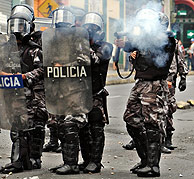
spectra in the coup attempt "or riot police?
Quito, October 7, 2010
day  following the events in a long interview with public television, Rafael Correa stated abundantly clear thesis official: the salary problem the police mutineers claimed publicly to justify his insubordination was a common excuse. There was an inte nt coup engineered by conspirators linked to the Patriotic Society Party of ex - President Lucio Gutierrez and, failing to arouse the plan of the armed forces opted to "plan B" to kill the President. Discontent with the changes in the remuneration scheme tions of the police could be the cause of the uprising because the Public Service Act, even eliminated bonuses for medals and promotions, total wages increased to include payment for overtime . Above all, stressed the President, government support for the institution would have been significant sharp increase in wages between 2007 and 2010, improved operating equipment, investments in physical infrastructure. Therefore, given their titanic public efforts soon forgotten, be felt deeply betrayed .
The thesis of the mutiny, p  or the contrary, argued that there was no coup attempt. He never made any claims go LPIS ta and virtually all senior police officers sought appeasement. The kidnapping or retention of the President, the danger who ran his life and the violence of the events linked to the rescue on the evening of Thursday, are due to the warming of the minds as went chaining improvised events caused by the fury of the moment. The decisive aspect of this outbreak of violence and kidnapping that threatened the country's institutional stability, would have been imprudent actions of the Chairman in the early hours of the morning when he went personally to the regiment nt No. 1 in Quito to solve the problem. They ended up losing his composure and defiance of the rebels: "Gentlemen, if you want to kill the President, here it is: kill me. If they please, kill me, if they have value, instead of being in the crowd, cowardly hiding (...). If you want to take the barracks, (...) If you want to betray their duty (...), if they want to destroy the country, destrúyanla (...) [I give] Not one step back. " This intervention warmed the mood and triggered the sequence of events leading to the mutiny gre convert mial in a kidnapping that could cost him his life .
What to make of these conflicting interpretations? The information is, of course, fragmentary, secret, impervious to scrutiny. We offer here a provisional and plausible speculation based on fragmentary information at our disposal.
alternative thesis
The first point to consider is that in the early hours of the morning, the police strike was not an isolated event in a particular battalion. It was a rally without police left the country. From the information available, only in the cities of Cuenca and Esmeraldas, the troops of the police returned to work after talks with his superiors. This indicates that there was conspiracy, there was also a massive boost to the "excuse" or union wage. How do you explain the massive support the ruling party? Basically by disinformation the agitators, the lies repeated use s that police had not read the law carefully and were unaware of the benefits it brings. In a word, cheating.
This explanation "intellectualism" is not satisfactory. It assumes that a very rare in Ecuador's history, a national police strike (the last dating back 1980), may be due to agitators who cheat easily amenable to mass. The truth is that agitation is effective only where the environment is receptive. Not only that, two senior officers, the Chief of the Joint Command of the Armed Forces, on Thursday, and Commander Chief of Police, when he resigned on Friday, in unusual acts, publicly demanded the revision of the measure. "They had not read it? Does not anyone read? The ruling recognizes that the Act removes award bonuses s and promotion but says it will compensate them with overtime. The practical difference is that the currently existing benefit is removed and change the criteria for allocating additional bonus: instead of "merit" in action, working time. The impact "identity" of change for the police seem to be as important, at least, as purely financial.
The issue had been debated in the National Assembly during the treatment of law by the executive. After intense discussions, the Assembly accepted the bargain: it included an exception for the armed forces and police, so they could continue to receive these bonuses. The President vetoed this exception in the law, did not accept the negotiation of the Assembly because it did not seem logical. In Ecuador TV interview, mentioned above, Rafael Correa said that if accepted these differences, all public sector institutions were entitled to their own exceptions, and if police wanted to keep these bonuses, then you should become entirely the old system and receive the amount of your old and small salary. All or nothing.
The same attitude has  been maintained by the executive in other legislation, which has ignored previous agreements or social parliamentary vetoes and restore the original proposals of central government. The most recent and similar is the Higher Education Act, which prior negotiation between the governing and the Assembly was entirely unknown to the President on the grounds that the vote final lacked the support of the opposition promised . These discrepancies reach to members of own party and government is what, as the President said, led him to seriously consider dissolving the National Assembly and call new elections for the remainder of the term of office. This mechanism, provided in the Constitution of 2008, was dropped after the crisis.
The radical thesis of conspiracy, which assumes the existence of a mass of ignorant and docile police handled, no seriously. is untenable. It is clear that, internally, the government should do another analysis. Own government spokesmen have suggested that, beyond the President's public speeches, they recognize that there is a deeper malaise that police would be at the root of the problem. Indeed, Alexis Mera, the head of the legal team of the President and prominent figure during the crisis, said it well in an interview with El Comercio newspaper:
The reports we have is that yes it does [Gustavo Jalk , minister of the interior, which does explain to the police the benefit of the law]. But it seems that there are people infiltrated that is making a propaganda against it. Gutierrez is not only the (...). Police have certain complicated structures that have been linked to secret expenses of the U.S. State Department. That was cut. More than two years and had incidents when the Ambassador arrived, the police came and took away a computer as his home. There are people who no longer have those benefits and is resentful. If these people want the American government continue to drive the police is wrong (...). There are plans to deliver the Immigration Police to another entity, delivering Traffic to municipalities, then there are officials who believe they are arenas of power and can affect (...). Officers are personal and dissatisfied with the decisions of government: the Truth Commission, investigating abuses by the police in the past 25 years.
legal secretary refers to institutional changes in recent years, which would add the abolition of the autonomy of intelligence, conducting several trials of police abuses in the fight against crime and the abolition of fees for participation in competitions for the entry of new recruits .
In short, the change wage occurred in a context of deep unease by the progress of reforms within the police. That is the breeding ground of the inner turmoil of the most reactionary of the officers and troops. Groups that are not necessarily fans of Lucio Gutierrez, but they can easily coalesce with him. Simplifying things, the overall government policy with the police can be interpreted as an attempt to compensate supports that are lost through the process of internal restructuring with significant wage concessions, equipment and infrastructure provision. But the purchase of loyalty is not as durable and stable as true loyalty.
We make synthetically the hypothesis: the work of agitators and conspirators of the military and police right there from the beginning of the government (which still exists after) has a growing influence in the police because there is widespread discontent and restlessness of the groups of officers 'hard', caused by the ongoing institutional reforms. The culture medium, clearly reactionary, he found a wider discontent, the part of the troops sought to maintain a benefit particularly valued: in their understanding of things, the additional benefits did not have to mean sacrificing the benefits existing. The government, not knowing hear or negotiate the subtopic of the bonus, provided the opportunity for the influence of hard and groups of conspirators. The personal challenge launched by the President on the morning of Thursday in Quito Regiment, worsened the situation. Obviously not caused it. Without the previous environment, it seems unlikely that the error would have had to suffer the terrible consequences.
Indeed, the publication of the radio communications of the rebels presented by the press on October 5 leave no doubt: many of those involved were willing at times more tense in the fray of the night, to kill the President. But there was a voice of unified command, the soldiers improvised. It is also clear that Rafael Correa was actually kidnapped, they were not willing to let him out unless they sign a commitment to the amnesty and the revision of the law. The President flatly refused. It is also clear that there were several people linked to Lucio Gutierrez in the facts: in Quito Regiment in the attack on public television. But, as Alexis Mera, not just the Gutierrez.
It seems plausible that the influence of this group, if any, is greater in the military , not folded into unemployment . The reason probably is that institutional changes are minor in Armed Forces in the police. Similar privileges have been lost to those who lost all other public agencies regarding commissaries exclusive clubs for family rest and medical services. But retained other important companies, command structures and operational controls. The decorations can imagine benefits under the police to the extent that there is less fighting and therefore the wage impact (and all moral - identity) of the Public Service Act could be lower. Above all, the traditional development policy of the government, to recover the state's role in the economy and revalued as a driver of a proposed enlargement and strengthening of patriotism, may be more sympathetic hearing from the officers of the army and armed forces in police.
reactions
Even if the claims against the Public Service Act can be considered fair, combined with the rejection of police reform and upheaval gutierrismo make this a reactionary rebellion. The popular and progressive organizations could only repudiate and fight. But it was not. Although social mobilization in defense of the government was swift and significant, was also quite modest, never had streams of people on the street. However, all surveys show that there was a massive repudiation of the possibility of a coup, the retention of the President and the attitude of the police that left undefended cities. The rejection was much larger among the popular sectors massively sympathetic to the government. But it's no organized support, capable of moving in time and direction. Depends on the spontaneous reaction of people. It is possible to speculate that there is much scope for support in the street grow if the situation worsened and persisted.
Above all, the initial police riot against the law of public service, was echoed in the morning in public unions unhappy about a rule that, in addition to the wage problem of the police, violates workers' rights. Attempts to talk union had crashed, as usual, against the government's refusal to negotiate the terms of the changes. These groups initially hoped disgruntled union support (and support) in claim police quickly retreated when, in the afternoon, the process was overflowed. I never would go out to defend the government. There were also isolated groups of students dissatisfied with the handling of the Higher Education Act, where the government also maintained an inflexible attitude, which came to support the police, but they disappeared after noon. Neither teachers rejected organized kidnapping, reflecting the harshness of the conflict that leaves the government even supported the draft General Education Act, now pending. Between indigenous organizations difficult internal negotiations on the position to adopt because of the continuing conflict and the humiliations they have received from the President and systematic attempts to undermine them now by the government. At noon, the organization decided to repudiate the coup while reaffirming their differences with the government . Was unable, therefore, to make any demonstration against the mutiny. Rural organizations closer to the government, as FENOCIN or CNC, condemned the coup but did not move. In summary, among the major popular organizations, past and repeated blows of the government have been too frequent to go out in his defense. It is the harvest of a systematic government policy of estrangement, intolerance, contempt and even persecution of organizations popular.
The result is that the most effective and immediate protection against the destabilization appeared to be in the armed forces and the international response. This time the danger was averted temporarily, but the lack of dialogue and the government obstinacy, not reactionary groups of conspirators, but to any progressive and organized force that could mobilize in their defense, subtracts allies that sooner or later will be indispensable. So as you can appreciate the presidential poise most tense moments of crisis is a grave mistake to keep the same attitude in all circumstances disregard all political negotiation with social organizations. They accumulate and add dangerously discontented sectors: agricultural policy, indigenous, labor, academic, among others. Not prevent the President's popularity remains high, but it alienated allies and politically active set. Overcome the resistance encountered (and which continue to find) for the most necessary reforms, require dialogue and negotiate with those who can support not only benefit individuals but by conviction history. The stubbornness in dealing with organized and active groups of the progressive sectors can be very expensive in the next confrontation with the most reactionary groups.
coup or mutiny "?
One of the arguments the President of the Republic against the riot simple thesis is that it was a trifle high and almost laughable. "It justified that the abduction or simply keeping against their will of the president? The hypothesis of this analysis is that it is something more 'than a purely demand wage. A matter of wages, but also identity, mixed with a broader corporate discontent in an institution too "complicated" (to use the expression of Alexis Mera) being affected in their feuds and their interests. It was a riot reactionary implications that went beyond the purely monetary. The conditions for a coup are not given, but there are always people working to create them. In the most intense moments of personal battle with unruly Correa could happen, if not the blow that was shown, to say the least, woefully unprepared, yes the President's death seems no less serious. A "corporate succession" would have followed his death by the rapid disintegration of a political movement dependent mortality figure.
Seen in a broader perspective, "was strengthened by the government? Hard to say. There a general repudiation of the police attitude and polls show an increase in the government's popularity. But in the medium term, the refusal to consider sectoral demands or building fronts based on dialogue between groups with similar approaches, potential social base erodes PAIS Movement and can lead to progressive aggregation of the growing private wrongs. Furthermore, the specific solution "police problem" appears very difficult: Where go the scissors to separate concessions steady hand? Anyway, there in the police, you can not find strong allies. The government needs to understand that you can not make the changes alone. Has to decide to choose allies rather than opening left and right fronts. Once chosen, if indeed allies must negotiate policies with them. Without building the arrogance agreements and change the dialogue, bills of conflict and uncertainty of the results likely will worsen in the near future.
BRIEF CHRONOLOGY OF EVENTS IN QUITO
07.30 Approximately 500 members of the Police took the Regiment Quito 1, Police headquarters in Quito, Ecuador's capital. The Police say their action was in claiming that the Public Service Law approved last night by the National Assembly, allegedly cut their profits. 09h00
Sectors of the armed forces carry out actions to support as members of the police in the streets of Quito. 09h40
President, Eq Rafael Correa, Quito Regiment goes to 1 for the purpose of having an encounter with the police unruly, however this is unsuccessful dialogue and is attacked and had to be moved on their shoulders to the Hospital Police, next to the Regiment, because of a recent operation in his right knee which underwent an implant. Is treated medically, but once recovered he is informed that he was not allowed to leave the hospital until they repeal the Public Service. 10h05
Military Police and taken the trail of Quito's Mariscal Sucre airport, preventing departures and arrivals of domestic and international flights. 10h24
is talk of a Kidnapping the First President of Ecuador by some members of the National Police. 11.00
Ecuador remains unprotected. Banks, shops, malls and other states closed and classes suspended until further order. The chaos began in the city. 11.30
launch the first demonstrations in support of President Correa in various parts of the country's capital. 12.30
telephone In a statement, President Rafael Correa speaks of a coup attempt and accused the former president of Ecuador and former Army General Lucio Gutierrez of being behind the police insubordination and claims that police are trying to enter into violent the hospital room where he is held. 13.00
starts a citizen mobilization to the exterior of the National Police Hospital where he is kidnapped by the President, in order to rescue him. They go unarmed citizens, presidential cabinet members, authorities, public servants, etc. Start a brutal police crackdown with tear gas at civilians who tried for hours to get to the gates of the hospital. 13.30
Legal Secretary of the Presidency of the Republic asked at a news conference that the armed forces take control of the situation and the security of Chief Executive. 13h50
state of emergency is decreed throughout Ecuador for a period of 5 days.
14.30 The Joint Command of the Armed Forces in conference press, urged the National Police to lay the attitude of certain elements of the police and the armed forces, calling for sanity and resolve conflicts through dialogue . 17.30
military leaders and Defense Minister arriving at Quito airport for talks with military troops. At 19h40 definitely opens the activities of the airport. 21h00
an operation was launched with 700 members of the armed forces who entered the Police Hospital to remove the President of the Republic in crossfire that ended the life a member of a panel of police guarding the vehicle in which the president was being transferred.
Other: In the absence of police on the streets of the country, recorded dozens of robberies, looting and other criminal acts that left a toll of losses thousands of dollars.
More specifically, noted that the Armed Forces are an institution subordinated to the legally constituted authority, but also said they want to reform the law. A reporter asked if it was conditioning its aid, the answer was no, but again insisted on changing the law